
News
Latest from the Coalition
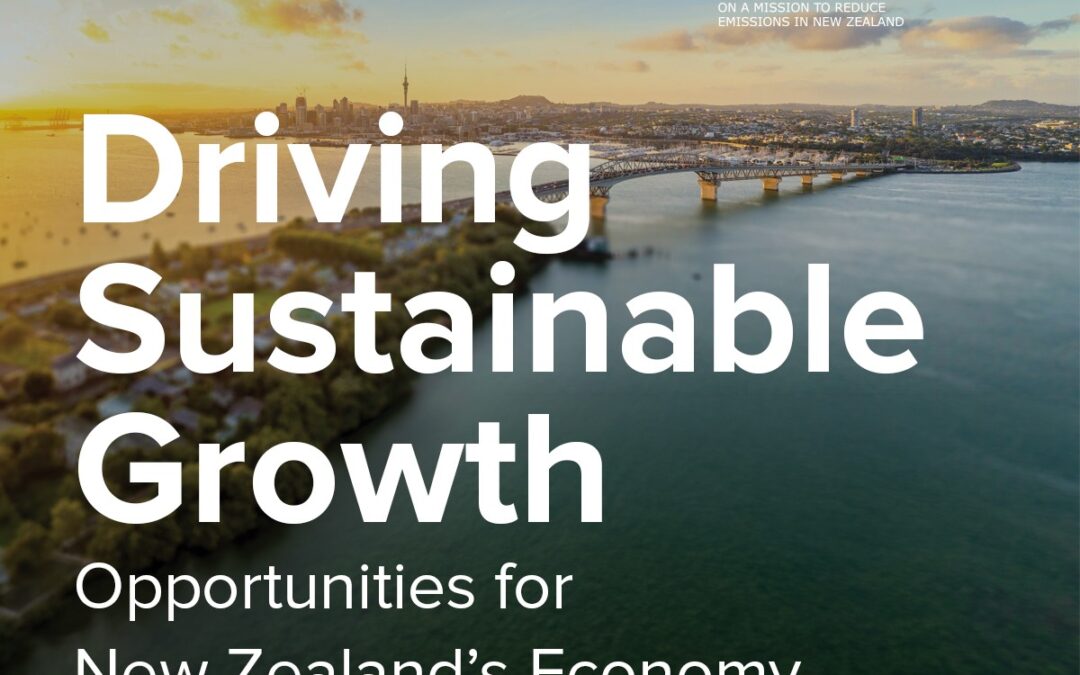
Business leaders quantify major sustainable growth opportunity for New Zealand economy
New Zealand could boost its economy by more than $22 billion per year by 2035, while strengthening productivity, energy security, and long-term resilience, according to a major new business-led report released today. The report, Driving Sustainable Growth:...
Climate Leadership Insights: The B Team Australasia
Lynette Mayne, Executive Chair of The B Team Australasia, recently visited Aotearoa New Zealand for the launch of the Climate Leaders Coalition’s new Statement of Ambition and refreshed strategy. In this Q&A, Lynette shares insights into the work of The B Team...

Climate Leaders Coalition launches next chapter
The Climate Leaders Coalition (CLC) is this morning unveiling a new Statement of Ambition and refreshed Strategy, marking the next step in business-led climate action in New Zealand – just as COP30 concludes in Belém.

SBC Hot Seat with Shannil Varma (CLC Manager)
This week, we've got Shannil Varma, Manager of the Climate Leaders Coalition (CLC), in the hot seat. Shannil's role sits within the Climate and Nature team at SBC (which is the secretariat organisation for CLC), and he oversees all the day-to-day operations and...
Search all news

IAG praises climate change adaptation milestone
New Zealand’s leading general insurer, IAG, has praised the introduction of the Climate Change Response (Zero Carbon) Amendment Bill to Parliament today as a milestone, as the country grapples with the issue of adapting to the consequences of climate change.
KiwiRail ready to play part in reducing greenhouse gas emissions
KiwiRail has welcomed today’s Zero Carbon Bill announcement, and is ready to play its part in reducing New Zealand’s greenhouse gas emissions.
“As a company we are committed to helping New Zealand move to a low-emissions future and meet the reduction targets,” says Group Chief Executive Greg Miller.
Toyota NZ supports introduction of Zero Carbon Bill
Toyota New Zealand welcomed today’s introduction of the Zero Carbon Bill to Parliament as an urgently-needed piece of legislation to address climate change. As an original signatory to the Climate Leaders Coalition and long-time member of the Sustainable Business Council (SBC), Toyota NZ is committed to reducing greenhouse gas emissions and sustainable business development.
Christchurch Airport supporting action on climate change
Chief Executive Malcolm Johns says the airport company recognises the Paris agreement and supports establishing an independent Climate Change commission and targets enshrined in law.
Synlait supports Zero Carbon Bill
Synlait (NZX: SML; ASX: SM1) applauds the government’s bold Zero Carbon Bill announcement today, including new methane targets.
These targets are aligned with Synlait’s commitment to sustainability announced in June 2018. Synlait has committed to achieve on-farm reduction of greenhouse gas emissions (GHGs) by 35% per kilogram of milk solids (kgMS) by 2028, including a reduction of methane by 30%.
New Zealand business leaders welcome Zero Carbon legislation
The Climate Leaders Coalition welcomes the Climate Change Response (Zero Carbon) Bill announced today.
Air New Zealand urges more passengers to offset travel
Air New Zealand is urging more passengers to join the war on climate change as its Fly Neutral voluntary carbon offset scheme passed the $NZ1 million milestone. The Kiwi carrier offsets staff travel and since late 2016 has allowed passengers to tick a box to offset the carbon emissions associated with their flight.
Increasing focus on low emission supply chains an opportunity
Increasing pressure on firms globally to reduce emissions throughout their supply chain is a genuine opportunity for New Zealand, Contact Energy says.
Chief generation and development officer James Kilty says there has always been a level of interest from firms overseas keen on seeing whether they could establish businesses here to take advantage of the country’s geothermal energy and its high – and growing – share of renewable electricity.
Ten tips for businesses who want to transition their company fleets to electric vehicles
More and more businesses are considering going down the road of electric vehicles. While it’s a good way to show business leadership on climate change, reduce emissions, and help create the critical mass of demand necessary to truly launch the EV market in New Zealand, it’s not quite as simple as replacing your company fleet with EVs and installing a few plugs. Here, some of New Zealand’s biggest corporates and members of the Climate Leaders Coalition, such as Meridian, Spark, Orion and Westpac, share what they’ve learnt when it comes to transitioning their corporate fleets into EVs.
New NZ Post delivery vehicles in Tawa
Tawa residents will now be able to see New Zealand Post’s new electric delivery vehicles in operation as driver training has started. NZ Post has worked closely with the Wellington City Council to gain approval to operate the Paxster electric delivery vehicles on a 12 month trial. The rollout of these vehicles around the country started in 2017, and the vehicles have now arrived in Tawa.
‘The equivalent of taking 18,500 cars off the road’: Fonterra’s latest move to reduce carbon emissions
Dairy giant Fonterra believes its latest initiative to cut carbon emissions could make the difference of the equivalent of taking 18,500 cars off the road. The co-operative’s Te Awamutu site has just completed a trial to run its existing coal boiler exclusively on wood pellets.
Why carbon measurement matters
“With employees and board members becoming increasingly aware of climate risks and motivated to protect the environment, measurement of carbon emissions will soon be a standard practice for New Zealand businesses.” Rob Campbell tells the National Business Review why SKYCITY Entertainment Group and Summerset Group Holdings Limited are measuring their carbon footprint with Enviro-Mark Solutions Limited (Subscription access).